IT Budget Planning for Accounting Firms: What Should You Prioritize First?
When everything feels important, how do you decide which technology investments your accounting firm actually needs?
As the leader of an accounting or CPA firm, you’re responsible for protecting sensitive client information, keeping your employees productive, and making smart financial decisions for your business.
But when it comes to your IT budget, those responsibilities can feel like they’re competing with each other.
Your accounting software needs an upgrade. Several computers are getting older. Your team keeps experiencing frustrating IT issues. Cybersecurity improvements are being recommended. And tax season is always closer than it seems.
Every expense sounds important.
But that doesn’t mean everything needs to happen right now.
You shouldn’t have to become an IT expert just to know you’re making the right technology decisions for your firm.
A good IT budget isn’t about spending more money. It’s about understanding which investments protect your clients, keep your team productive, and help your firm operate with confidence.
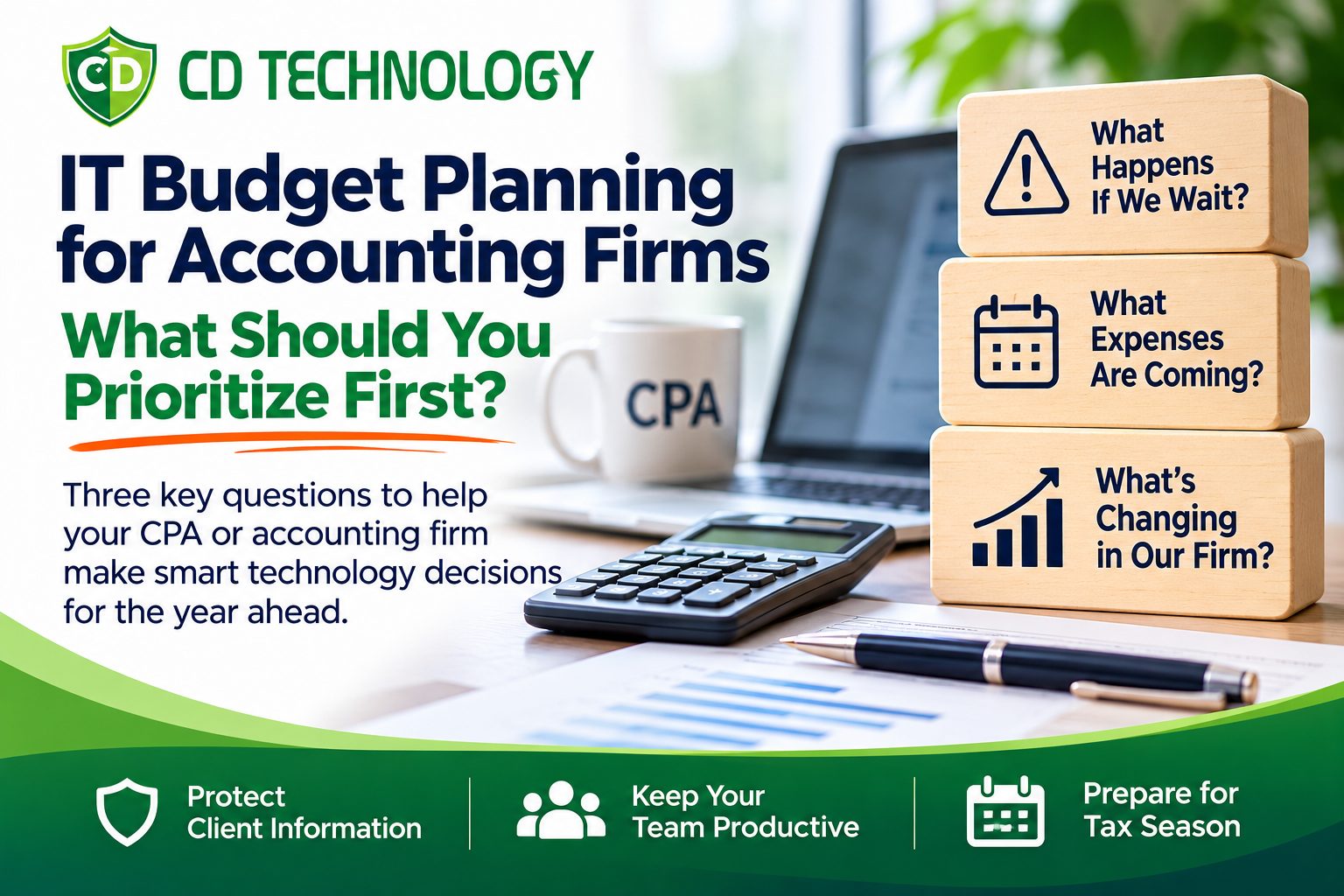
Here are three questions every accounting firm leader should ask before finalizing an IT budget.
1. What Happens to Our Accounting Firm If We Wait?
Not every technology issue requires immediate attention.
But some problems become much more expensive when they’re ignored.
An aging computer that still performs reliably may be able to wait another quarter.
A recurring network problem that interrupts your team’s work is a different story.
And a cybersecurity vulnerability that could expose sensitive client financial information deserves a completely different level of attention.
Before deciding whether to approve an IT expense, ask yourself:
- Could this problem prevent our employees from serving clients?
- Could it expose sensitive financial or tax information?
- Could it cause downtime during tax season or another critical deadline?
- Are we creating additional cybersecurity or compliance risks by waiting?
- Will this problem become more expensive to fix later?
For accounting firms, the cost of an IT problem isn’t always reflected in the repair bill.
It’s also the hours your employees lose waiting for systems to work, the deadlines that become harder to meet, and the uncertainty of not knowing whether your firm’s information is adequately protected.
Your IT budget should prioritize the problems that put your clients, productivity, and business operations at the greatest risk.
That’s where a responsive IT partner can make a difference.
Instead of simply recommending new equipment or software, your provider should help you understand the business consequences of waiting—and which investments deserve attention first.
2. What Technology Expenses Do We Already Know Are Coming?
Some of the most frustrating IT expenses aren’t unexpected.
They’re simply expenses nobody planned for.
Consider what happens when your accounting firm hires additional employees before tax season.
Those new team members may need:
- Computers and monitors
- Microsoft 365 accounts and licenses
- Access to accounting and tax preparation applications
- Secure remote access
- Cybersecurity protection
- Properly configured user permissions
- IT onboarding and ongoing support
None of those needs should come as a surprise.
The same applies to software renewals, equipment warranties, security subscriptions, backup services, and planned system replacements.
When these expenses aren’t included in your IT budget, they can turn into last-minute decisions that put unnecessary pressure on your firm’s finances.
A proactive IT plan helps you prepare for technology expenses before they become urgent.
Review your upcoming costs and ask:
- Which software licenses and subscriptions will renew this year?
- Are any computers or servers approaching the end of their supported life?
- Will we need additional technology for seasonal or permanent employees?
- Are our cybersecurity and backup systems keeping pace with our needs?
- What technology investments should be completed before our busiest periods?
For many accounting firms, timing matters as much as cost.
A technology upgrade that would be manageable during a slower month could become a major disruption if it’s scheduled during tax season.
Planning ahead gives your firm more flexibility, fewer surprises, and greater confidence that your team will have the tools it needs when deadlines matter most.
3. What’s Changing in Our Accounting Firm?
Your technology should support where your firm is going—not just where it is today.
Maybe you’re planning to hire additional accountants.
Perhaps you’re expanding into advisory services, opening another office, acquiring a smaller practice, or allowing more employees to work remotely.
Each of those decisions can create new technology requirements.
For example, expanding remote work may require a closer look at:
- Secure access to accounting applications
- Microsoft 365 security settings
- Multifactor authentication
- Employee devices and endpoint protection
- Secure client document sharing
- Backup and recovery procedures
- Access controls for sensitive client information
Opening a second location brings another set of considerations, including internet connectivity, network security, equipment, software access, and reliable IT support across offices.
And as your firm grows, so does the importance of making sure the right employees have access to the right information.
Your IT budget should reflect your firm’s growth plans while helping protect the client trust you’ve worked hard to build.
Before approving next year’s technology spending, ask:
Will our current systems, security measures, and IT support still meet our needs as our firm grows?
If you’re not confident in the answer, that uncertainty deserves attention before new employees, clients, or locations are added.
Don’t Forget Cybersecurity and Compliance When Planning Your IT Budget
For accounting firms, cybersecurity isn’t just another technology expense.
Your clients trust you with tax records, financial statements, personal information, and other sensitive data.
Protecting that information is an important part of protecting your firm’s reputation.
That’s why cybersecurity should be a deliberate part of your IT budget—not something you address only after a problem occurs.
Depending on your firm’s activities and applicable requirements, planning may include reviewing:
- Multifactor authentication and access controls
- Email security and phishing awareness
- Endpoint protection and security monitoring
- Data backup and disaster recovery
- Secure client file sharing
- Written Information Security Plans (WISPs)
- Applicable FTC Safeguards Rule and other data protection responsibilities
Your IT provider should help you identify technology gaps, understand potential risks, and prioritize appropriate safeguards.
Technology can support your compliance efforts, while your firm’s specific legal and regulatory obligations should be confirmed with qualified advisors.
The goal isn’t to purchase every cybersecurity product available.
It’s to make informed decisions about the protections your firm needs.
Your Accounting Firm Shouldn’t Have to Treat Every IT Expense Like an Emergency
A smarter IT budget starts with knowing the difference between what’s urgent, what’s important, and what can wait.
Some investments help protect sensitive client information.
Others prevent recurring IT problems that slow your team down.
And some prepare your firm for growth, new employees, or changing business needs.
The right IT partner should help you make those decisions—not leave you trying to figure them out alone.
At CD Technology, we understand how frustrating it can be to lead an accounting firm when you’re never completely sure whether your technology is being handled properly.
For more than 25 years, we’ve helped East Tennessee businesses stay productive and secure.
We provide managed IT services for accounting firms, proactive cybersecurity, technology planning, and responsive IT support. During normal service hours, we typically begin resolving IT issues within 20 minutes.
Our goal is simple: help protect your sensitive client information, keep your accounting team productive, and take ownership of your IT so you can focus on leading your firm.
Build an IT Budget That Protects Your Firm and Supports Your Growth
You don’t need to know everything about computers, networks, or cybersecurity to make smart technology decisions.
You need an IT partner who understands your business, explains your options clearly, and helps you prioritize investments based on what matters most.
Here’s how to get started:
- Schedule a free 10-minute discovery call. Tell us about your firm’s technology concerns, upcoming expenses, and business goals.
- Get a clearer picture of your IT priorities. We’ll discuss your current challenges and help identify areas that may deserve closer attention.
- Move forward with a plan that fits your firm. Understand what needs attention now, what to prepare for next, and what may be able to wait.
Stop worrying about whether you’re spending money on the right technology.
Start making confident decisions that help protect your clients, support your employees, and prepare your accounting firm for what’s next.