
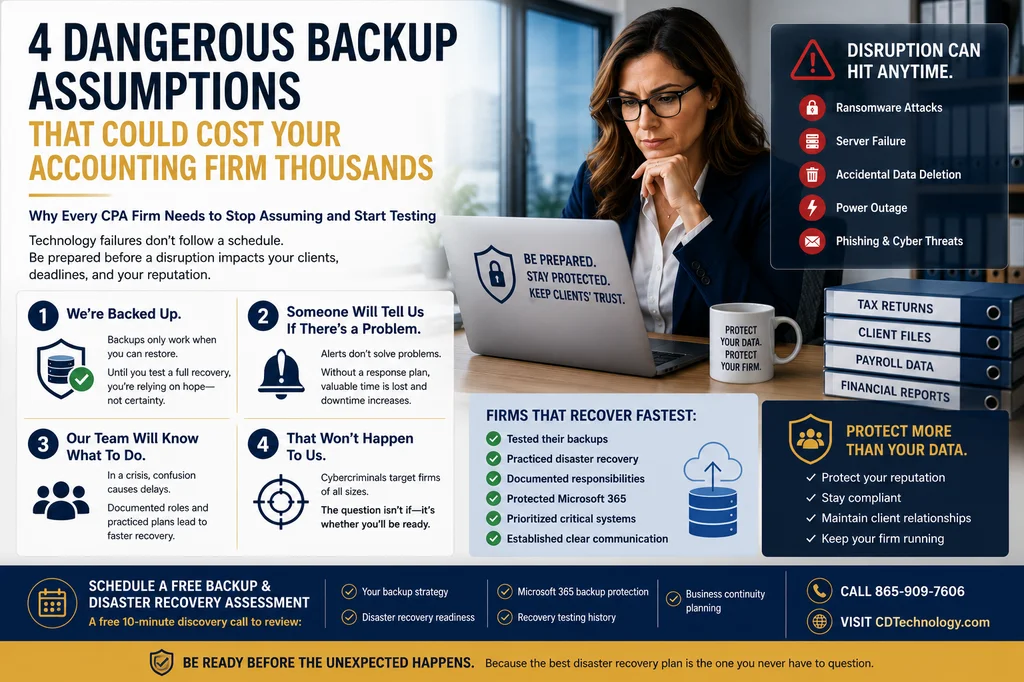
Why Every CPA Firm Needs to Stop Assuming and Start Testing
Mike Tyson famously said,
"Everyone has a plan until they get punched in the mouth."
For accounting firms, that "punch" often comes in the form of a ransomware attack, server failure, accidental data deletion, or unexpected system outage.
The real problem isn't the disruption itself.
It's discovering that the backup and disaster recovery plan you trusted doesn't actually work the way you thought it would.
Too many accounting firms operate on assumptions when it comes to protecting client data.
Here are four of the most common—and most expensive.
Assumption #1: "We're Backed Up."
Most accounting firms have backup software.
That doesn't necessarily mean they're protected.
A backup only proves its value when you successfully restore from it.
Unfortunately, many firms can't answer questions like:
- When was our last recovery test?
- How long would it take to restore our systems?
- Are Microsoft 365, OneDrive, and SharePoint included?
- Are QuickBooks, tax software, and document management systems backed up?
- What happens if ransomware encrypts our entire network?
Many firms see green checkmarks and backup reports and assume everything is fine.
But until you've tested a full recovery, you're relying on hope—not certainty.
Ask Yourself:
If your server failed tomorrow morning, how confident are you that your team would be back to work quickly?
Assumption #2: "Someone Will Tell Us If There's a Problem."
Today's security tools are incredibly good at detecting problems.
They'll send alerts.
Generate notifications.
Flag suspicious activity.
But alerts don't solve problems.
Think of it like a weather warning.
Knowing a hurricane is coming doesn't protect your home.
You still have to prepare.
The same applies to cybersecurity.
Monitoring tools tell you something happened.
Your recovery plan determines what happens next.
Without a documented response process, valuable time is lost while everyone tries to figure out who's responsible.
The Better Question Is:
Who responds to security alerts—and how quickly?
Detection without action still results in downtime.
Assumption #3: "Our Team Will Know What To Do."
Imagine it's March.
Tax season is in full swing.
Your firm's systems suddenly become unavailable.
Who takes charge?
Who contacts your IT provider?
Who communicates with employees?
Who informs clients if deadlines are affected?
Who restores Microsoft 365?
Who verifies client data is intact?
Many firms assume everyone will naturally know what to do.
Unfortunately, that's rarely the case.
Without a documented disaster recovery plan, even experienced teams lose valuable time deciding what happens next.
The firms that recover fastest aren't necessarily the ones with the best technology.
They're the ones that have already practiced their response.
Just like a fire drill.
Assumption #4: "That Won't Happen to Us."
No accounting firm expects to become the next cybersecurity headline.
Most believe they're too small.
Too local.
Too careful.
Unfortunately, cybercriminals don't see it that way.
Accounting firms are attractive targets because they store:
- Tax returns
- Social Security numbers
- Payroll information
- Banking details
- Financial statements
- Personally identifiable information (PII)
In many cases, disruptions don't begin with sophisticated attacks.
They begin with ordinary events:
- Someone clicks a phishing email.
- A Microsoft 365 account is compromised.
- Hardware fails.
- A power outage corrupts data.
- An employee accidentally deletes critical files.
The question isn't if your firm will experience disruption.
The question is whether you'll be prepared when it happens.
The Accounting Firms That Recover Fastest Don't Rely on Luck
Every accounting firm experiences technology issues eventually.
The difference is preparation.
Firms that recover quickly have already:
- Tested their backups
- Practiced disaster recovery
- Documented responsibilities
- Protected Microsoft 365
- Prioritized critical systems
- Established clear communication plans
They aren't trying to create a recovery plan during an emergency.
They're simply following one.
Protect Your Clients Before Disaster Strikes
Your clients trust you with their most sensitive financial information.
They expect your firm to remain available—even when technology fails.
A tested backup and disaster recovery plan protects more than your data.
It protects your reputation.
Your compliance.
Your client relationships.
And your ability to continue serving clients without interruption.
Schedule a Free Backup & Disaster Recovery Assessment
At CD Technology, we help accounting firms throughout East Tennessee strengthen cybersecurity, reduce downtime, and prepare for unexpected disruptions.
During a free 10-minute discovery call, we'll review:
✅ Your backup strategy
✅ Disaster recovery readiness
✅ Microsoft 365 backup protection
✅ Recovery testing history
✅ Business continuity planning
We'll help you identify what's been tested, what's been assumed, and where your firm may have hidden risks.
Be Ready Before the Unexpected Happens
📞 Call 865-909-7606
🌐 Visit www.CDTechnology.com
Because the best disaster recovery plan is the one you never have to question.